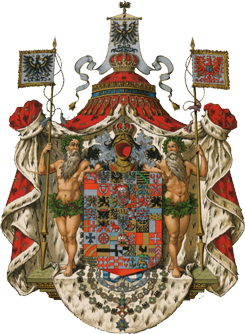

Königreich Preußen
Großes Wappen Preußens um 1873
Kolberg is a city and former fortress in Pomerania, on the Persante River, near its confluence with the Baltic Sea; 16,027 inhabitants. Since 1873, the fortifications of K. are closed, only the fort and four trenches from the sea remain. Steam sawmills, agricultural machinery factory, iron foundry, sources of strong salt water. There are 8 well-adapted bathing establishments in which you can also use mud and steam baths. K., being on the seashore, represents a good sea bathing station, which allows you to combine the action of brine baths with strengthening sea air or alternate sea baths with brine. K. is recommended to be golden, unblooded and recovering from wasting diseases. K. is a very old city that arose from a Slavic fortress; in 1284 he was admitted to the Hanseatic League. At the beginning of the 7-year war, its garrison consisted of only 700 police and disabled people. After the battle of Zorndorf, the Russians decided to take possession of K. in order to have a safe point for a stock warehouse and for communication with the fleet; however, the attempts made for this were unsuccessful until the case was entrusted to Rumyantsev, who approached her in August 1761, with a detachment of about 15 thousand people. At this time, near Kolberg, in a fortified camp, there was a Prussian detachment (18 thousand), under the command of the Prince of Württemberg; to assist Rumyantsev, the fleet of Admiral Mishukov arrived from the sea, bringing up to 7 thousand reinforcements. The siege began on September 2; at the end of October, the Prince of Württemberg, due to lack of food, was forced to leave K., but the fortress, thanks to the courage of the commandant, Major Heyden, continued to hold on until December 5 (16) and surrendered only for lack of supplies. During the war of 1806-1807. K. was severely constrained by the French, under the command of Marshal Victor, but resisted, thanks to the commandant, Major Gneisenau, Schill's bold partisan actions and the patriotism of the inhabitants. Brockhaus and Efron Encyclopedic Dictionary
***
KOLBERG, mountains. and ex. pruss. 3 cl. from Balt. sea, on the river. Persante. Ukriya K. abolished in 1873. The city has 4 suburbs, of which naib. value - per ber. sea and accommodates the port. Port K. is formed by two embankments covered by b-ray. In 1630, Gustav Adolf landed at the mouths of the Oder and besieged K. Ok. 10 t. Emperor. troops, under the head. Torquato Conti, gathered in strong fortified. camp on the river. Oder, approx. Harz, and tried to supply K. with food. Besides, Conti sent means. forces for the liberation of K. These last b. attacked on one side of the Swede. troops expelled by Gorn from Stetin, and on the other - Kniphausen, besieging K. and b. defeated. In the beginning. 1631 K. surrendered to the Swedes. They firmly established themselves in it and strengthened the building. In 1653, the Swedes returned K. Brandenburg. In 1758, 1760 and 1761 the Russians besieged K. and captured him. - Siege of 1758. In the campaign of 1758 (Seven Years' War), after the battle of Zorndorf, Russian. army d. b. retreat to the cities of Poland, since it had no support. points in the prus. possessions. The head general Fermor during this movement separated br-du, under the beginning. g.-m. Palmbach, to master K. Possession of this cross gave the opportunity to bring the sea directly to the theater of war. actions necessary supplies, and in case of failure to have a reliable support. item. Fence K. looked wrong. 5-ug-ka and consisted of earthlings. bastion. fronts, old. location, from heaven. ravelins. Front I - ii (see table, drawing 1), facing the camp and, locally. position, more others available is gradual. attack, b. reinforced by a miner and had a cavalier in the bastion. Heads. the strength of the fence was in the shire. water. ditches with flowing water, with cabins arranged in them. batardo. In 1757, the K. g-zone consisted of 700 hours, under the beginning. the brave Major Heyden; armament - 130 push., Four - 24-fn. klb. and 14 morts. But art. servants b. little and it b. replenished by volunteers. The besieging detachment consisted of 4 pp infantry (approx. 3 tons), 3 escs. kav-rii, 2 esk. hussar, 8 3-fn. and 6 12-fn. guns and 6 unicorns. Ing. the works were supervised by the engineering regiment. Ettinger. October 3. The Russians approached K. and took a position near the village of Zelno (in 3 ver. on the road to Stetin). Next day. they took up a position near the village of Maikule and opened fire on the city (b-ray No. 1). Then b. built b-rei No. 2, 3, 4 and conducted approaches b, c. But 8 oct. gen. Palmbach received neozhid. order to lift the siege. Then he invited Heiden to surrender and, having received a refusal, opened a bombing, which did not lead to a result. Oct. 9 Palmbach lifted the siege and, passing approx. 10 vers. on Gros Gustin, met the regiment. Yakovleva, who came with means. detachment and order to continue the siege. As a result of this, next day. Palmbach returned to K. and, finding all his works not destroyed, again proceeded to the siege. The attack was carried out from two sides: the main one - from the Minden forstadt, near the beginning. arrived at the siege. K-su general apartment f. - Stoffelna; auxiliary - with curtains. Lauenburgsk. forstadt, under the head. regiment. Ettinger.
Siege of Kohlberg fortress in 1807.
Darkness and strait. rain helped them break into the redoubt and force g-zones (12 officers. and 254 n. h.) for delivery. Then they repelled 3 k.-ataki French. reserves and retreated by morning, destroying all buildings. The Shiel hussars once again intercepted Mortier's report that in order to accelerate the attack from Wolf Mountain, he decided to storm Lauenburgsk. suburb. Then Gneisenau ordered to lay a new dugout. b-ray-blockhouse t on the islet amid the Frauenmarktwiese flood. On the night of June 17, Gneisenau decided to make a sortie in order to capture b-rei No. 17, 20. To distract the Frzov, he ordered the Shil detachment to attack the village of Zelno. Shil attacked this village so energetically that he knocked out a fr-call from it, and when reserves began to gather there, he retreated. The sortie was also successful: the Prussians riveted 6 op. and captured 60 hours. After this good luck, the Prussians decided to attack the Wolf Mountain and in the afternoon with music went on the attack, but b. repulsed with loss for 400 hours. On June 23, the Frs laid the 2nd par l against the Wolf Mountain, connected it with the 1st par-liu and soon laid the 2nd par l on the south. front. They then attacked the redoubts g, h, but b. repulsed. Having received support approx. 6 t. People, Frerz, after reinforced bombing, made an assault on June 1, K.-aprosh. works surrounding K. Prussians repelled this assault, and repulsed the assault on Lauenburg. the suburb was greatly facilitated by the longitudinal. blockhouse fire t on the island. At the same time as this assault, the Frs attacked the grove at Maikule with 5 bunks and took possession of this position and the Munde redoubt, and this closed the ships' entrance to the harbor. Although the attack on the Cooling Plant and b. repulsed by the Prussians, they had to clear the plant, since the Frz with the occupation of Maikule cut off the retreat. Soon the Frs attacked the redoubts g, h and at the time when the Prussian Kav-riya was ready to rush to their flank, on all b-rei b. the white flag was hoisted, heralding the conclusion of an armistice. Thus ended the brilliant defense of K., which lasted 3 ½ months. The losses of the Prussians amounted to approx. 2 vol. (Journal of the war. actions by Ross. Imper. armies, part I, II, III, ed. 1761-63; Freeman, History of Kr-si in Russia; Maslovsky, Rus. army to Semilet. war; Engman, Defense lie. sukhop. kr-stey). Military Encyclopedia (Sytin, 1911-1915)
***
Kohlberg - a resort on the Baltic Sea (Prussia); there is a Jewish community. In 1905, over 22,000 inhabitants, of which 336 were Jews. There is a Jewish resort hospital (2/3 places are free) with a capital of 146,000 marks and a budget of 46,000 marks (basics. in 1873). The number of patients in 1905. Jewish Encyclopedia of Brockhaus and Efron